
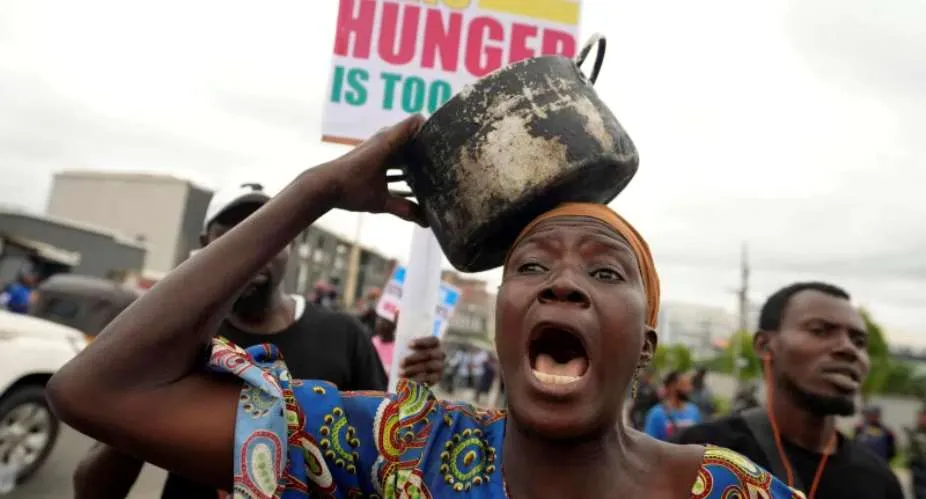
Who Eats, Who Starves, and Why

Dear Bayelsans,
When did we become a people who accept eating from the crumbs of our table? When did Bayelsans, whose ancestors controlled the trade routes of the entire Niger Delta, become beggars in our oil-rich land? The time has come to answer these questions with our actions, not our prayers.
If you are a persistent reader here, you already know that this hunger exists not despite our oil wealth, but because of how that wealth is organised. It is the fallout of an extractive, exploitative capitalist system that focuses not on the people but on profit.
The Scale of the Crisis: Official Statistics and Hidden Reality
The official statistics reveal a crisis that defies belief, though we believe that the reality on the ground suggests even these numbers underestimate the suffering that we Bayelsans currently endure. Our state recorded 39.85% year-on-year food inflation in May 2025, making it the second-highest in Nigeria! More shocking still, we had the highest month-on-month food inflation in the entire country at 12.68%, meaning food prices increased by over 12% in just one month!
University students at Federal University Otuoke is reported to now spend an average of ₦3,000 daily on food. This totals ₦90,000 monthly, exceeding Nigeria’s ₦70,000 minimum wage. You are spending just on food money that is beyond minimum wage? This means that if you don’t have money, you are to starve, outright!
Students skip meals to afford textbooks. Our families eat once daily where they once ate thrice. Hungry children turn to crime and prostitution whilst oil worth hundreds of billions flows beneath their feet to foreign markets. We witness organised starvation alongside engineered abundance. An estimated 389,215 people in our state, that is 14.4% of us, experience acute food insecurity whilst we live above an ocean of crude oil worth trillions. Think about this: every seventh person you meet on the street faces serious hunger daily! They are one push away to death by starvation, and Bayelsa State is not in an active military war zone! We are, however, fighting a war without even knowing it: a class war.

How This System Creates Our Hunger: The Machinery of Dependency
The food crisis strangling us is not a natural disaster but engineered dependency. Our 39.85% food inflation exists because the same system that extracts billions in oil wealth has systematically destroyed our capacity to feed ourselves.
Brothers and sisters, over 430 oil spills happened in our state in 2024-2025, destroying our livelihoods. These spills have poisoned our farmlands and fishing grounds that once sustained our communities. When Shell and Chevron contaminate fishing waters in Otuasega, Kolo Creek, and Nembe, they create people who are forced to buy exorbitantly priced imported rice from Thailand through Lagos importers. When the reckless gas flaring destroys our soil fertility, our farming families must purchase food they once grew themselves.
This environmental destruction results from the extractive system’s normal operations, and the results then get exploited by other capitalist interests. Whether planned or not, each dead fishing ground in the creeks, in the streams, and in our villages becomes both an environmental catastrophe and an economic opportunity for those who control food distribution. In a literal sense, there are people who benefit from our starvation. Never forget this.
The Training Theatre: How Government Wastes Our Money
As these devastating conditions unfold, we must ask: what is the state government doing? They spent months campaigning in every nook and cranny to get into office, promising to represent and protect our interests. Now these same officials are neck-deep in creating and maintaining our food crisis, and we let them. Shame on us, Bayelsans! As we have analysed in previous articles, this is fundamentally a class issue. The state apparatus, Governor Diri and his commissioners, work hand in hand, directly or otherwise, with international markets and federal vampires to ensure our continued suffering whilst they extract maximum profit.
The evidence is damning. Dr. Paul Ebikabowei John, the Director General of the State Commodities and Export Development Agency, operates the most sophisticated food racket in our state. His agency requires registration for any trader wanting to export food. By their mandate, “if you are not registered, you are not entitled to move the products out of the state.” Currently, only 38 registered exporters can legally move food out of Bayelsa. His agency also charges ₦2,000 per truck for any food leaving Bayelsa, creating artificial scarcity. He admits that Bayelsa “consumes only 2.5%” of locally produced food – meaning 97.5% gets exported and then “brought back to the state at exorbitant prices.” This describes EXACTLY what his tollgate system facilitates! He creates the very problem he claims to solve.
The question every hungry Bayelsan must ask: if this system truly helps us, why do we still have the highest food prices in Nigeria? If these “controlled prices” benefit the masses, why are students spending ₦90,000 monthly on food? If the registration system prevents exploitation, why do many of us face acute food insecurity?
Prof. Beke Sese, our Commissioner for Agriculture and Natural Resources, oversees massive state agricultural assets operating “below optimum level” whilst controlling access to oil palm estates, aquaculture complexes, and processing facilities. Despite admitting these assets operate below capacity, he retains control over agricultural investment decisions. Why reward incompetence with job security, unless it is for a purpose? Dr Ebieri Jones, Commissioner for Trade, Industry & Investment, oversees all import-export licensing and determines who can legally import food into Bayelsa and under what terms.
Whether these officials personally profit or genuinely believe their methods help, the results speak clearly: Bayelsa is food insecure, and the current regulatory systems and training programmes are ineffective. The system serves interests other than feeding hungry Bayelsans.
Listen to what our government calls agricultural development. They boast about training 677 youths across various programmes, handing out ₦300,000 to each of 600 trainees – a total of ₦180 million in cash payments. How much industrial farming does ₦300,000 buy? How many hectares can one person mechanise with such pocket change? How will individual handouts fix mass hunger when families need ₦90,000 monthly just to eat?
The results? Governor Diri himself admits, “We are yet to see any positive results.” He has discontinued all cash incentives and directed his Commissioner for Agriculture to investigate how the funds were actually used. Can you believe this? They spend our money and then investigate themselves when nothing works!
The figures expose deeper theft. If our entire ₦16.65 billion agriculture budget were divided among these 677 trainees, each would theoretically receive ₦24.6 million. They received only ₦300,000 each. Where did the remaining ₦24.3 million per trainee disappear to? Into whose pockets?
My people, while we face food insecurity, look at what our government actually spends money on in 2025:
Governor’s Personal Comfort:
- ₦20.6 billion for the Governor’s Office – (yearly) more than our entire agricultural budget
- ₦5.5 billion for Government House maintenance – (yearly) luxury living whilst students spend ₦90,000 monthly on food.
- ₦5 billion for “Special Adviser, Political Matters” – creating political jobs whilst people starve.
- ₦1.8 billion for the Deputy Governor’s Office – comfort for one person whilst thousands hunger
Wasteful Procurement:
- ₦12.3 billion for government motor vehicles – that’s 74% of our entire agricultural budget! For cars!
- ₦10.2 billion for “Security Equipment” – mysterious spending with no accountability.
- ₦3.3 billion for office furniture – enough to establish food cooperatives employing thousands
- ₦2.3 billion for office generators – private power for officials whilst we suffer blackouts
- ₦1.9 billion for computers – whilst our schools lack basic equipment
- ₦617 million for kitchen equipment – government canteens whilst people starve
- ₦461 million for photocopying machines – more than many local governments spend on agriculture
Just these items total over ₦63 billion – nearly four times our entire agricultural budget of ₦16.65 billion. They spend more on photocopying machines than some communities see in their entire annual budget.
Who Benefits from Our Hunger: Understanding the Classes
My fellow Bayelsans, the political class and contractors control agricultural budgets that disappear into training programmes producing “no positive results”. They award contracts for demonstration farms producing 832 metric tonnes annually against claimed targets of one million tonnes. That represents 0.083% of announced goals! Can you imagine such failure in any serious business?
Their counterparts, a tightly connected network of import cartels, profit massively from our food dependency. They have no interest in local food production because our dependency guarantees their wealth. They import rice, tomatoes, fish, and other staples at prices that undercut our local producers whilst extracting enormous profits through government licences, currency allocations, and import waivers.
The International Machinery of Extraction
Global food corporations and international financial institutions profit from our food dependency. They sell us seeds, fertilisers and processed foods and now are pushing to sell us subscription-based GMO seeds, whilst discouraging local production through unfair trade agreements.
Their “market solutions” systematically starve us whilst their markets guarantee our dependency. The oil companies extract our resources whilst forcing environmental costs onto communities that can no longer feed themselves. This creates the perfect cycle: resource extraction destroys local food production, forcing dependency on imported food that enriches the same international system extracting our resources.

Why Reform Cannot Work: The State Serves Them, Not Us
Every month, oil worth hundreds of billions flows through pipelines beneath our feet to Lagos banks and London shareholders. Every month, we spend increasing percentages of income on imported food. The system functions exactly as designed because the same classes that control oil extraction control food policy. Politicians who profit from import cartels cannot be expected to build food self-sufficiency. The officials who waste our agricultural funds cannot be trusted with genuine development programmes. The oil companies that poison our farmlands cannot be partners in environmental restoration.
When officials allocate ₦55.5 billion to their own comfort whilst a growing percentage of us face food insecurity, they reveal the state’s true function: maintaining political class luxury whilst managing our impoverishment. We have said it before, but we say again, reform cannot resolve this contradiction because the same class forces that created food dependency control the reform process. The state serves as an executive committee for oil companies and import cartels, not an instrument of development for us.

The Revolutionary Alternative: What We Could Achieve
Brothers and sisters, our state possesses every material precondition for food security except the political organisation to achieve it. With oil revenues exceeding ₦689 billion annually, we command sufficient resources to eliminate hunger completely within five years under a revolutionary government organised by and for working people.
Why Socialist Planning Works
Development is not sporadic; it is organised. Na people dey do am. Societies under socialist programmes have solved food security even starting from positions far worse than ours. China eliminated famine and became food self-sufficient. Cuba achieved food security despite blockades.
Vietnam transformed from food importer to exporter through planned development. These accomplishments happened not through market forces but through people-governments that prioritised human needs over private profits. The technical knowledge exists. The financial resources exist. The human labour exists. What prevents implementation is the class character of our current government.
How We Could Use Our Oil Wealth
A revolutionary government would deploy our oil wealth through state-controlled development directed toward food production. Instead of allocating billions to government luxury, we would fund:
I. State Agricultural Development Bank: ₦200 billion providing zero-interest loans for mechanised farming, processing facilities, and storage infrastructure controlled by agricultural cooperatives.
II. Integrated Food Industrial Complexes: Processing centres transforming our rice, cassava, fish, and vegetables into finished products for local consumption. These would employ thousands whilst keeping value-added production within our communities.
III. Community Infrastructure Revolution: Road networks connecting every farming community to processing centres. Cold storage facilities eliminating post-harvest losses. Distribution systems delivering food directly from producers to consumers.
IV. Community Agricultural Councils: Every ward elects representatives determining local food production targets, coordinating with neighbouring communities, and ensuring resources flow to actual producers rather than political contractors.
V. Environmental Restoration Fund: ₦100 billion annually for comprehensive clean-up of oil-contaminated farmlands and fishing grounds, forcing multinational corporations to pay full costs of remediation.

What We Must Do: The Tasks Before Us
Fellow Bayelsans, the evidence overwhelms any defence of the current system. There is no gain in stating these again. But the same statistics that expose our oppression reveal our revolutionary potential. Therefore, we at Tukpa Boyemi Movement have drafted immediate revolutionary demands for the Diri government to implement to alleviate the suffering of Bayelsans!
We demand from the Bayelsa government:
- Feed the Hungry Now: Free community kitchens in every ward providing three meals daily, funded by redirecting the ₦12.3 billion for government vehicles.
- Stop Wasting Our Money: Redirect the ₦20.6 billion Governor’s Office budget, ₦5 billion for political advisers, ₦3.3 billion for office furniture, ₦10.2 billion for mysterious “security equipment”, and ₦2.3 billion for office generators, and use the cumulating ₦41.4 billion to buy and distribute food directly to starving families.
- Create Real Jobs: Use the ₦20.6 billion Governor’s Office allocation to create 25,000 paid jobs in farming and fishing cooperatives instead of political patronage positions.
- Give Us Land and Tools: Redirect the ₦1.9 billion for government computers and ₦617 million for kitchen equipment to provide free land access, seeds, fertiliser, and farming equipment for communities wanting to grow food.
- Let Us Control Food Planning: Eliminate the ₦5 billion “Special Adviser, Political Matters” position and establish elected Community Food Councils in every ward with power to control agricultural budgets and food distribution.
Building Our Movement
Fellow Bayelsans, real revolutionary change that leads to genuine development requires us to organise and connect our struggles, because no one works in isolation. It starts with all of us in our communities.
Share with your neighbours what you have learned here. Show them that their individual problems, whether it is expensive food, lack of opportunities, or environmental destruction, are not personal failures but systemic issues. Organise in your workplace, your school, your market stall. When you see these patterns of government failure and elite consumption, connect them to your daily reality. Link up with workers pushing for better conditions. Your individual struggle becomes powerful when joined with others.
This is what Tukpa Boyemi is building – a movement that connects all our struggles into one fight for a new Bayelsa. A Bayelsa where oil wealth funds development instead of elite comfort. Where young people have futures in agriculture and industry instead of having to leave. Where communities control their own development instead of waiting for politicians who serve themselves. A Bayelsa where food security becomes the foundation of human dignity rather than a luxury reserved for the wealthy.
Join the Tukpa Boyemi struggle today! Join us to end the vampiric system that treats your survival as a profit opportunity.
The light is coming. And when it arrives, every Bayelsan will eat with dignity from the organised labour of Bayelsan hands, in a society that has eliminated both poverty and the system that creates it.
This is not utopia. This is development. Na people dey do am.
Comments
One response
Hi, this is a comment.
To get started with moderating, editing, and deleting comments, please visit the Comments screen in the dashboard.
Commenter avatars come from Gravatar.